The Birdwoman History Almost Forgot – The Story of Jamal Ara

Author: Dharmik Bhatt
Step outside early in the morning.
Before traffic builds. Before conversations begin. Before the world fully wakes up.
For a few brief moments, birds carry the soundscape of the day. Calls overlap from trees, rooftops, electric wires, ponds, and distant fields. Most of us hear those sounds without thinking much about them. But there was once a woman in India who spent years listening carefully enough to turn those sounds into science.
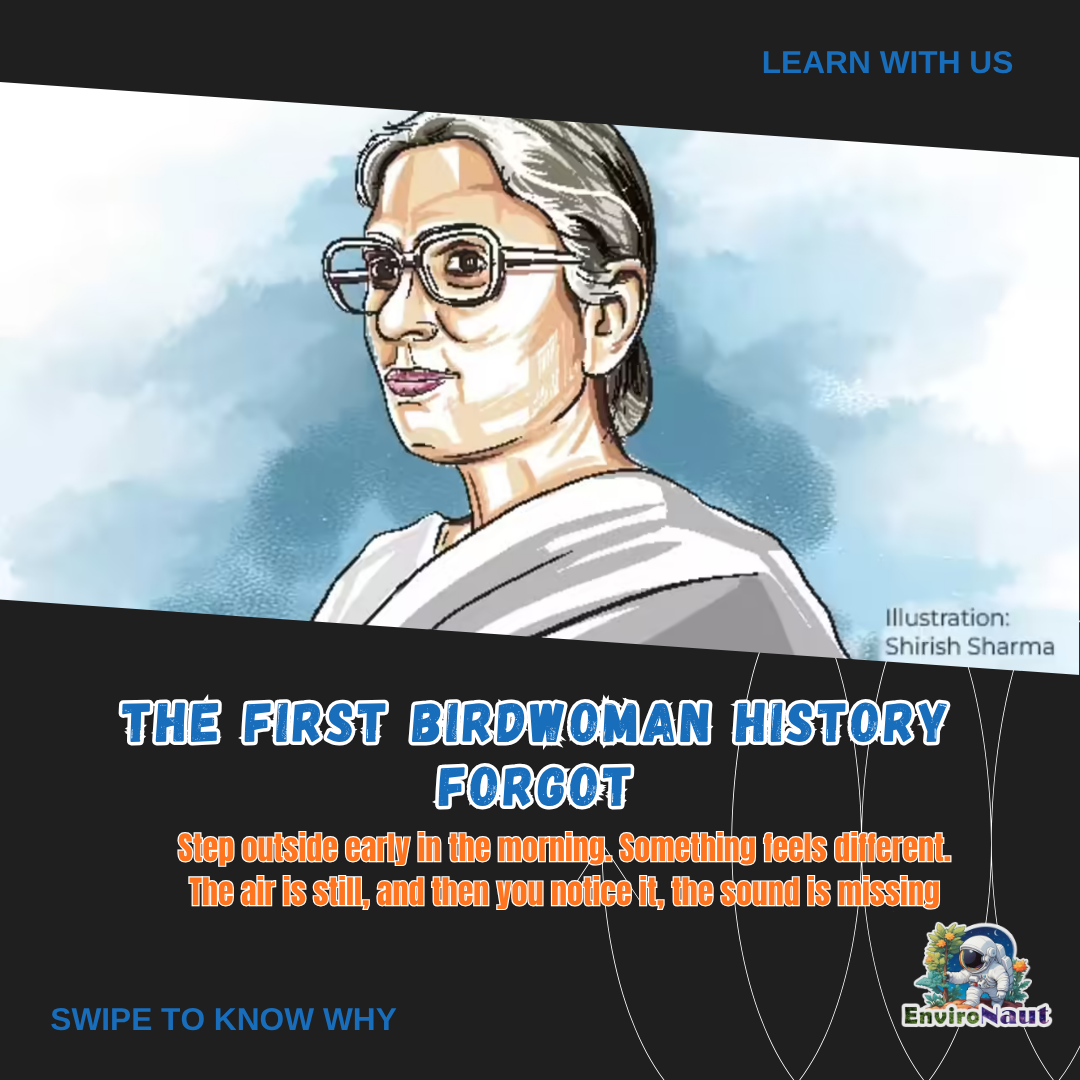
Her name was Jamal Ara.
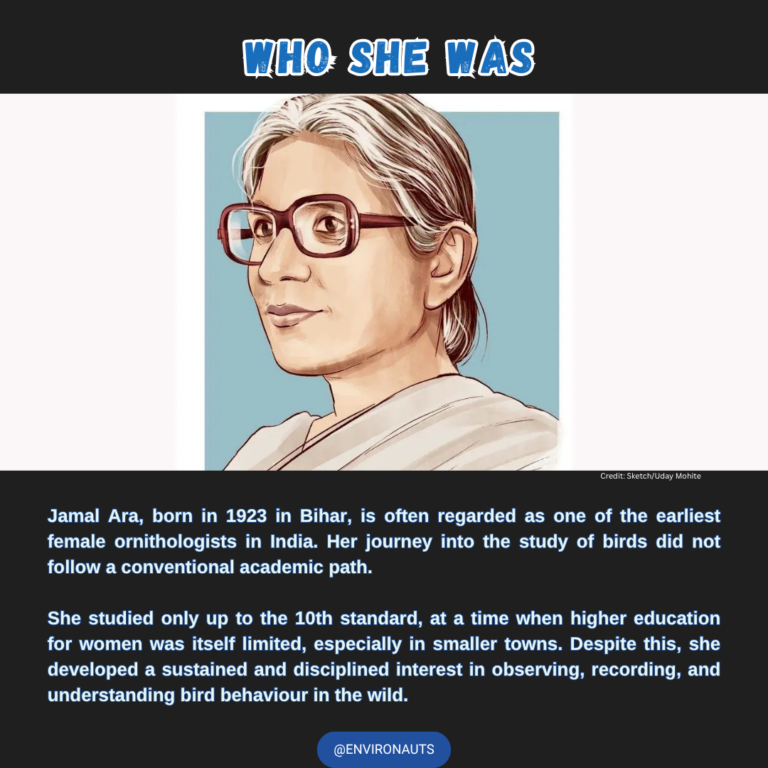
Today, very few people know who she was. In fact, only a single known photograph of her survives. Much of her writing, field notes, and personal archive disappeared long ago. Yet scattered across old journals and historical references is the record of someone who quietly became one of India’s earliest female ornithologists, a woman whom Salim Ali himself reportedly referred to as the country’s first “birdwoman.”
What makes her story remarkable is not only what she achieved, bu
t the circumstances in which she achieved it. She was born in Bihar in 1923, during a period when higher education for women remained inaccessible across much of India, especially outside major cities. Jamal Ara studied only up to the 10th standard. By conventional standards, her journey into science should have ended there.Instead, it began.
Learning Outside Institutions
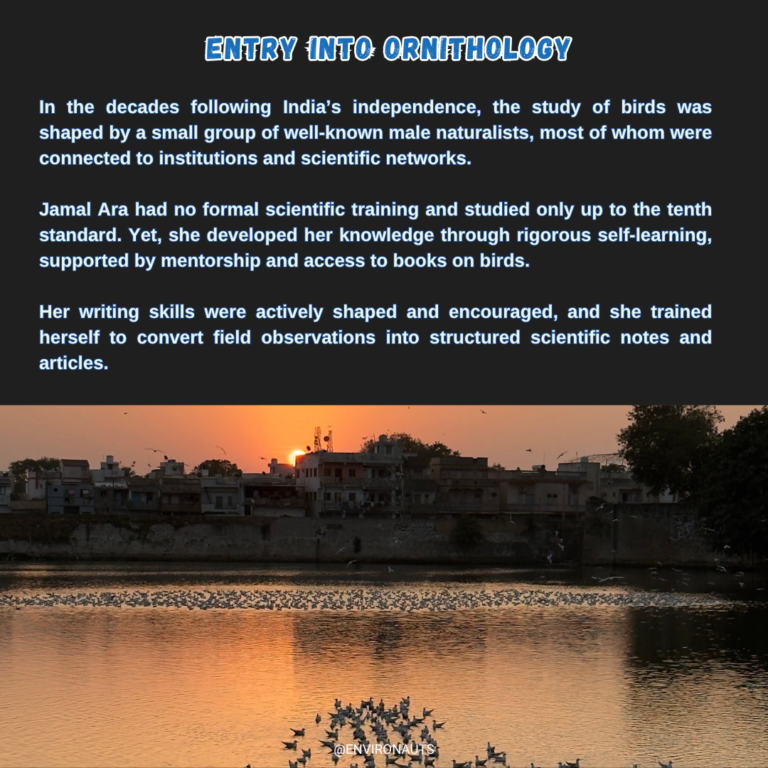
In the decades following independence, Indian ornithology was dominated by a relatively small network of male naturalists, researchers, and institutional scientists. Access to journals, libraries, mentors, and field networks mattered enormously.
Jamal Ara had almost none of those advantages.What she did have was persistence.
According to later accounts, she received guidance in bird study from Mrs. E. M. Nicholson, whose mentorship helped shape her early understanding of how to observe and record birdlife. It was not formal university training, but it gave her an entry point into a world that was otherwise difficult to access.
From there, Jamal Ara continued largely through self-learning.She read extensively.
She trained herself to observe carefully. More importantly, she learned how to transform field observations into structured scientific notes, the kind that could withstand scrutiny in scientific journals.That transition matters more than it may initially appear.
Many people observe nature. Very few learn how to document it systematically. Jamal Ara taught herself how to bridge that gap.
The Forests of Chota Nagpur
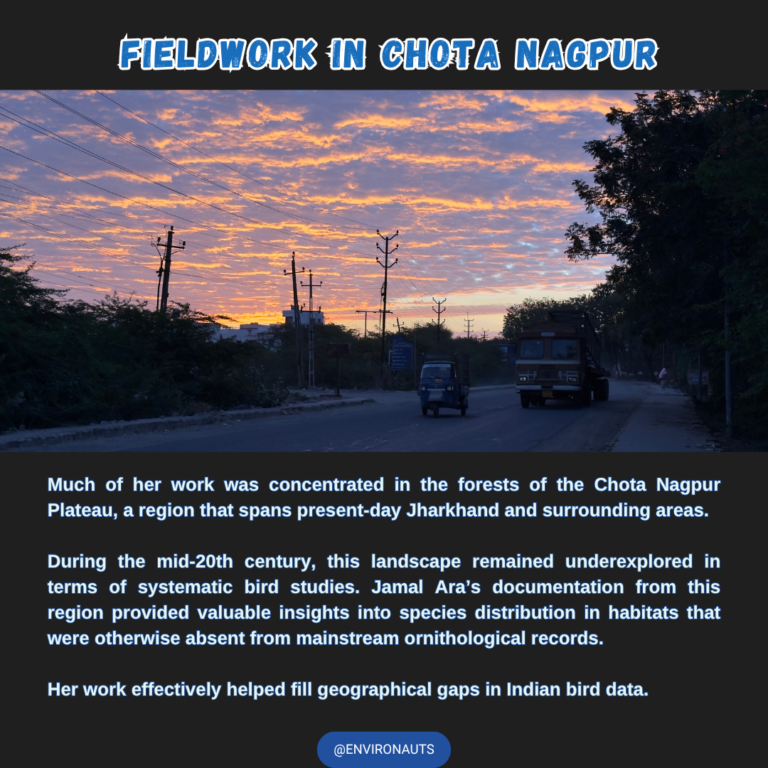
Much of her work unfolded in the forests and landscapes of the Chota Nagpur Plateau, spanning parts of present-day Jharkhand and surrounding regions.
At the time, these areas remained underdocumented in terms of systematic bird studies. Large portions of India’s biodiversity existed beyond the attention of mainstream scientific networks concentrated in urban centers. Jamal Ara worked in those overlooked spaces.
She recorded species distribution, habitat behaviour, ecological patterns, and wildlife observations from regions where little formal documentation existed. Her work helped fill geographical gaps in ornithological knowledge during a period when even baseline ecological information for many areas remained incomplete.
Unlike the image people often associate with science, laboratories, equipment, and institutions, her work was rooted in patience and field observation. Walking landscapes. Watching movements. Listening carefully. Writing things down before they disappeared.
Writing Science Into the Record
Over time, Jamal Ara published more than 60 articles, including contributions to the Journal of the Bombay Natural History Society.
These were not casual nature essays. They were scientific observations: behavioural notes, habitat records, species documentation, and ecological studies that contributed to India’s growing body of ornithological knowledge.
This achievement becomes even more striking when placed in historical context. She was operating in a field with very few women, limited institutional support, and minimal visibility. Yet her observations were considered rigorous enough to enter scientific circulation.
That alone says something about the quality of her work.But Jamal Ara’s interests extended beyond birds.
She also wrote and translated literary works, including translations of Punjabi writer Kartar Singh Duggal’s stories and novels. Her intellectual life moved across science and literature, suggesting a mind that resisted being confined to a single discipline.
The Tragedy of Disappearance
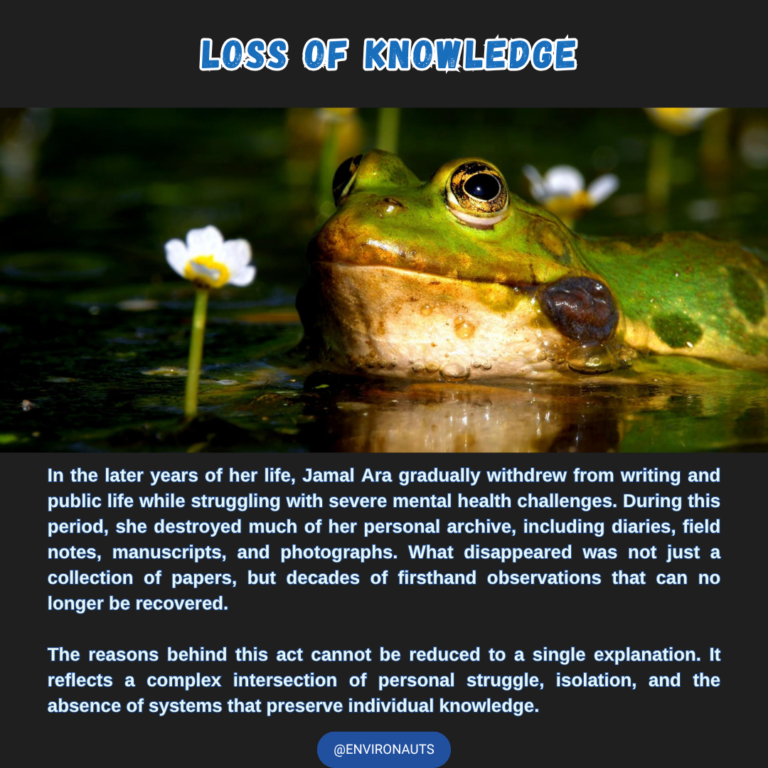
And then, much of it vanished. In the later years of her life, Jamal Ara struggled with severe mental health challenges and gradually withdrew from public and intellectual life. During this period, she destroyed a large part of her personal archive, diaries, manuscripts, field notes, and photographs accumulated across decades.
What disappeared was not merely paper. It was a memory. Observation. Time.
For researchers and historians, archives are often the only bridge between a person and posterity. Without preservation, even important work can fade into obscurity.
That is exactly what happened to Jamal Ara. When she passed away in 1995, her name slowly receded from mainstream discussions in Indian ornithology. Unlike more institutionally protected figures, her legacy remained fragmented across scattered references, journals, and recollections.
Only much later did renewed efforts begin attempting to piece together her story again.
Why Her Story Matters Today.
Why Her Story Matters Today.
There is something deeply unsettling about the fact that we live in an age obsessed with information, yet still allow stories like hers to disappear.
We often assume that significance guarantees remembrance. History repeatedly proves otherwise.
Recognition depends not only on achievement, but on preservation of who gets archived, cited, documented, institutionalized, and continuously discussed. Jamal Ara’s story sits at the intersection of science, gender, memory, and loss.
It reminds us that important knowledge does not always emerge from prestigious institutions. Sometimes it comes from people working quietly at the edges of visibility, documenting worlds others fail to notice. And it reminds us how fragile that knowledge can be.
Today, when we hear birds at dawn, most of us will move on with our day without a second thought.
But somewhere in India’s forgotten scientific history was a woman who listened closely enough to leave behind an entire body of work from those sounds.
Even if history almost lost her.
Follow Us on
You may also like